



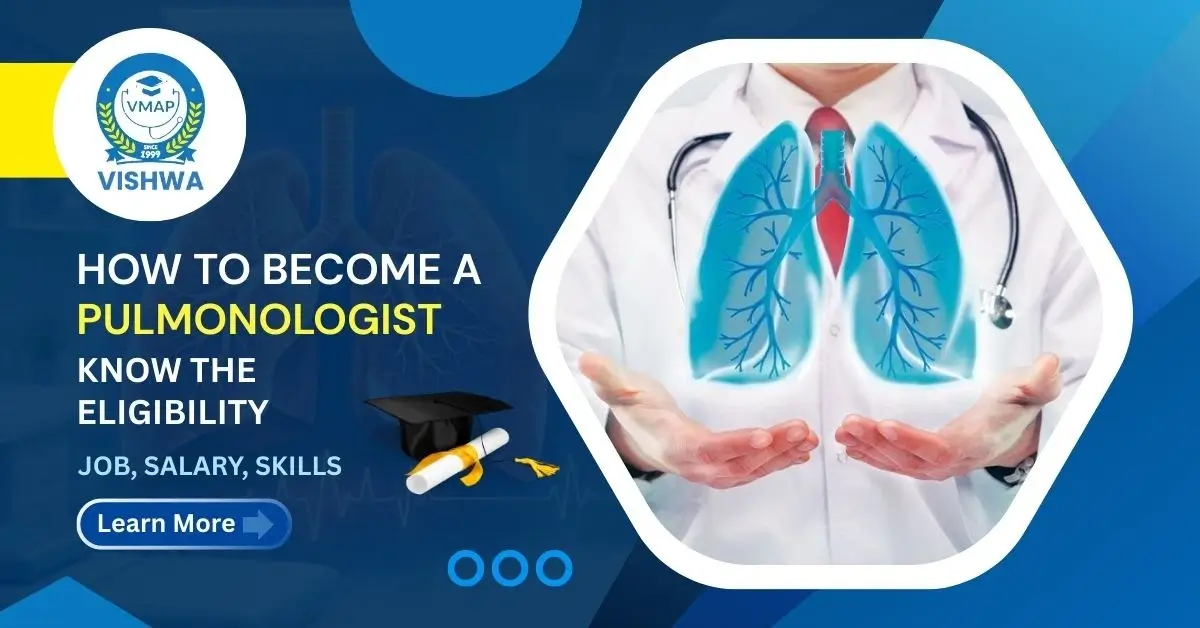
If you show interest in lung health and respiratory problems, you can explore how to become a pulmonologist for a fulfilling medical career. Pulmonologists identify and manage diseases such as asthma, chronic obstructive pulmonary disease, and infections in the lungs. This specialty expands because respiratory illnesses increase globally every year.
For instance, experts predict a shortage of around 1,400 pulmonologists in the United States by the year 2030, which demonstrates the high need for trained experts.
This article outlines the necessary steps from basic education to advanced specialization, including choices for studying in foreign countries. These options prove especially useful for students from India who seek international medical programs.
What Does a Pulmonologist Do?
A pulmonologist, whom people also call a chest specialist, treats disorders related to the lungs and the entire breathing system. These doctors conduct diagnostic tests like spirometry and oversee ventilators in intensive care units. They collaborate with other medical professionals on complicated cases including lung cancer or sleep disorders.
As a result, pulmonologists must develop excellent skills in solving problems and showing patience during treatments. Many of these specialists also engage in research activities or teach medical students, which brings diversity to their daily work routines.
Educational Requirements to Become a Pulmonologist
You begin the process of how to become a pulmonologist by building a strong base in scientific subjects during your school years. High school students need to concentrate on biology, chemistry, and physics to prepare adequately for higher studies.
After completing high school, you should enroll in a bachelor’s degree program in medicine or a closely related scientific field. However, the main phase starts when you enter medical school and study fundamental topics such as human anatomy and disease pathology.
Eligibility Criteria for Pulmonology Training
People often search for eligibility details when they learn about how to become a pulmonologist.
- Candidates must complete a medical degree such as MBBS (Bachelor of Medicine and Bachelor of Surgery).
- Clearing required entrance examinations is mandatory for admission to postgraduate training.
- Practical clinical experience is usually required before specialization.
- In India, qualifying NEET-PG is essential to enter advanced pulmonology programs.
- For overseas options, DM Pulmonology eligibility typically requires an MD degree.
- Proof of English language proficiency, such as IELTS, is often needed for international applicants.
- Some countries may also ask for prior work experience in the relevant field.
Always check country-specific rules to avoid issues during the application process.
Steps to Become a Pulmonologist in India
In India, you follow a clear but challenging sequence to achieve your goal of how to become a pulmonologist.
- First, you complete the Bachelor of Medicine and Bachelor of Surgery program, which lasts approximately five and a half years including a mandatory internship period.
- Next, you must succeed in the National Eligibility cum Entrance Test for Postgraduate to start a Master of Doctorate in internal medicine or respiratory medicine, which takes three years to finish.
- Finally, you pursue a Doctor of Medicine in pulmonary medicine for super-specialization, adding another three years to your training.
Altogether, this path requires about eleven to twelve years after high school graduation. Prestigious institutions like the All India Institute of Medical Sciences provide excellent training opportunities, although available seats remain quite limited.
Pulmonologist Study Abroad Options
Numerous students select pulmonologists to study abroad to gain access to modern equipment and international medical practices. Popular destinations include the United States, the United Kingdom, and Germany, where training programs emphasize research methods and direct patient care.
At Vishwa Medical Education Point, we serve as a study abroad consultant and have assisted students with their application processes successfully.
For example, we helped one student obtain a fellowship position in the United States by preparing for the United States Medical Licensing Examination and handling visa interview requirements.
This kind of hands-on guidance helps build confidence in how to get admission into desired programs without major hurdles.
To compare options clearly, here is a table that lists key countries for medical super specialty abroad in pulmonology:
| Country | Eligibility | Duration | Approximate Fees (in USD) | Key Notes |
| USA | Bachelor of Medicine and Bachelor of Surgery or Doctor of Medicine, United States Medical Licensing Examination Steps 1 through 3, residency in internal medicine | 2-3 years fellowship | 50,000 – 100,000 per year including costs for living | Demand remains high; you need board certification to practice. Pulmonology abroad fees sometimes decrease with available scholarships. |
| UK | Bachelor of Surgery, Professional and Linguistic Assessments Board or equivalent, foundation training program | 4-5 years specialty training | 40,000 – 80,000 per year | Integrated with the National Health Service; training focuses on developing clinical abilities. |
| Germany | Bachelor of Medicine and Bachelor of Surgery, proficiency in German at B2 level, Approbation licensing examination | 5 years residency | 10,000 – 30,000 per year due to public funding support | Public universities offer free tuition; programs stress research components strongly. |
| Australia | Bachelor of Surgery, Australian Medical Council examinations, internship completion | 3-4 years advanced training | 60,000 – 120,000 per year | Healthcare system provides vibrant opportunities; positions exist in rural regions as well. |
This table highlights differences among countries, so you can research more based on your personal qualifications and preferences.
Pulmonology Course Abroad: What to Expect
When you enroll in a pulmonology course abroad, you experience a mix of theoretical lessons and practical rotations in hospitals. For example, fellowships in the United States cover intensive care management and procedures like bronchoscopy for examining airways.
These courses prioritize medicine based on scientific evidence, which equips you to handle actual patient scenarios effectively. Fees and entry requirements differ across programs, but many accept international applicants who demonstrate strong academic records.
Chest Specialist Course Overseas: Training Details
You build specialized knowledge in thoracic oncology through a chest specialist course overseas. In the United Kingdom, the training includes strategies for handling tuberculosis cases, which occur frequently in varied populations. Such courses typically span four to six years and demand previous medical qualifications for admission. They also provide chances to connect with professionals, which can improve your employment opportunities upon returning to your home country.
Challenges and Rewards in the Field
The journey to how to become a pulmonologist presents difficulties like extended working hours and decisions with high responsibility. However, you receive substantial benefits from this profession in return for your efforts. By the year 2030, the worldwide impact of respiratory diseases will likely increase, creating more positions for qualified doctors.
Pulmonologists usually earn competitive salaries that match their level of specialized knowledge. Additionally, you find great personal satisfaction in assisting patients to improve their breathing and overall quality of life.
Skills Needed for Success
You need precise attention to detail when interpreting chest X-rays as a pulmonologist in daily practice. Strong communication abilities help you explain medical diagnoses clearly to patients and their families. For instance, during patient consultations, you use straightforward language to foster trust and understanding. Analytical thinking supports you in making accurate differential diagnoses among similar conditions. Empathy plays a crucial role in caring for individuals who suffer from long-term respiratory illnesses.
Fellowship and Certification
After finishing your residency training, you must complete a fellowship in pulmonary and critical care medicine to advance further. In India, this corresponds to the Doctor of Medicine level of specialization. Abroad, similar programs exist but involve different qualifying examinations for completion.
Obtaining certification from organizations like the American Board of Internal Medicine enhances your professional credibility. This process ensures you stay current with the latest standards and practices in pulmonology.
Career Outlook and Job Market
You can expect a positive job market as you pursue how to become a pulmonologist in the coming years. With populations aging rapidly, the need for respiratory specialists continues to grow steadily. In the United States, overall physician employment projections indicate increases, while pulmonology faces ongoing shortages.
In India, hospitals in urban areas actively recruit trained specialists for their teams. Opportunities abroad allow you to broaden your professional experiences significantly. At Vishwa Medical Education Point, we highlight this expansion to encourage students on how to get admission into leading educational institutions.
How Long Does It Take?
Many people inquire about the total time required for how to become a pulmonologist in their planning. The duration varies between ten and fifteen years depending on the chosen country and program structure. In India, you complete the process faster if you remain within domestic institutions. Studying abroad adds extra time for preparing examinations and adapting to new systems. You should create a detailed plan to manage your studies alongside personal commitments effectively.
Costs Involved in Training
You encounter various expenses during the training to become a pulmonologist that accumulate over time. In India, fees for Master of Doctorate and Doctor of Medicine programs range from 50,000 to 3.5 million Indian Rupees each year. For pulmonology abroad fees, you anticipate higher costs, although scholarships can reduce the financial burden considerably. Remember to allocate a budget for examination fees, travel expenses, and daily living costs in your calculations.
Tips for Aspiring Pulmonologists
- You should acquire early hands-on experience by volunteering in hospital settings to build practical skills.
- Keep yourself informed by reading professional journals such as the American Journal of Respiratory and Critical Care Medicine regularly.
- Attend medical conferences to network with experts and find potential mentors in the field.
- Maintain a healthy balance between work and personal life to prevent exhaustion during intensive training periods.
These recommendations help you navigate the path of how to become a pulmonologist more effectively.
Conclusion
In conclusion, grasping how to become a pulmonologist prepares you for an essential position in healthcare services worldwide. Whether you train in India or opt for pulmonologist study abroad, dedication remains key to success in this specialty. At Vishwa Medical Education Point, our role as a study abroad consultant demonstrates that proper assistance on how to get admission leads students to accomplish their objectives. Persistence truly yields positive results in this evolving medical discipline.
Also Read
How to Become a Gastroenterologist
How to Become a Nephrologist
How to Become a Pathologist
How to Become a Psychiatrist